Home / Case studies / Warm Springs Power Pathway Website
Warm Springs Power Pathway Website
Client / Partners
Portland General Electric & Confederated Tribes of the Warm Springs Reservation of Oregon
What I did
- Role: UX Developer, Project Management
- Timeline: Ongoing (5–6 year infrastructure project)
Tools / Platform
- Platform: Squarespace, custom HTML/CSS/JavaScript, ArcGIS, Jotform, Weglot
- Focus: Accessible public communication, bilingual engagement
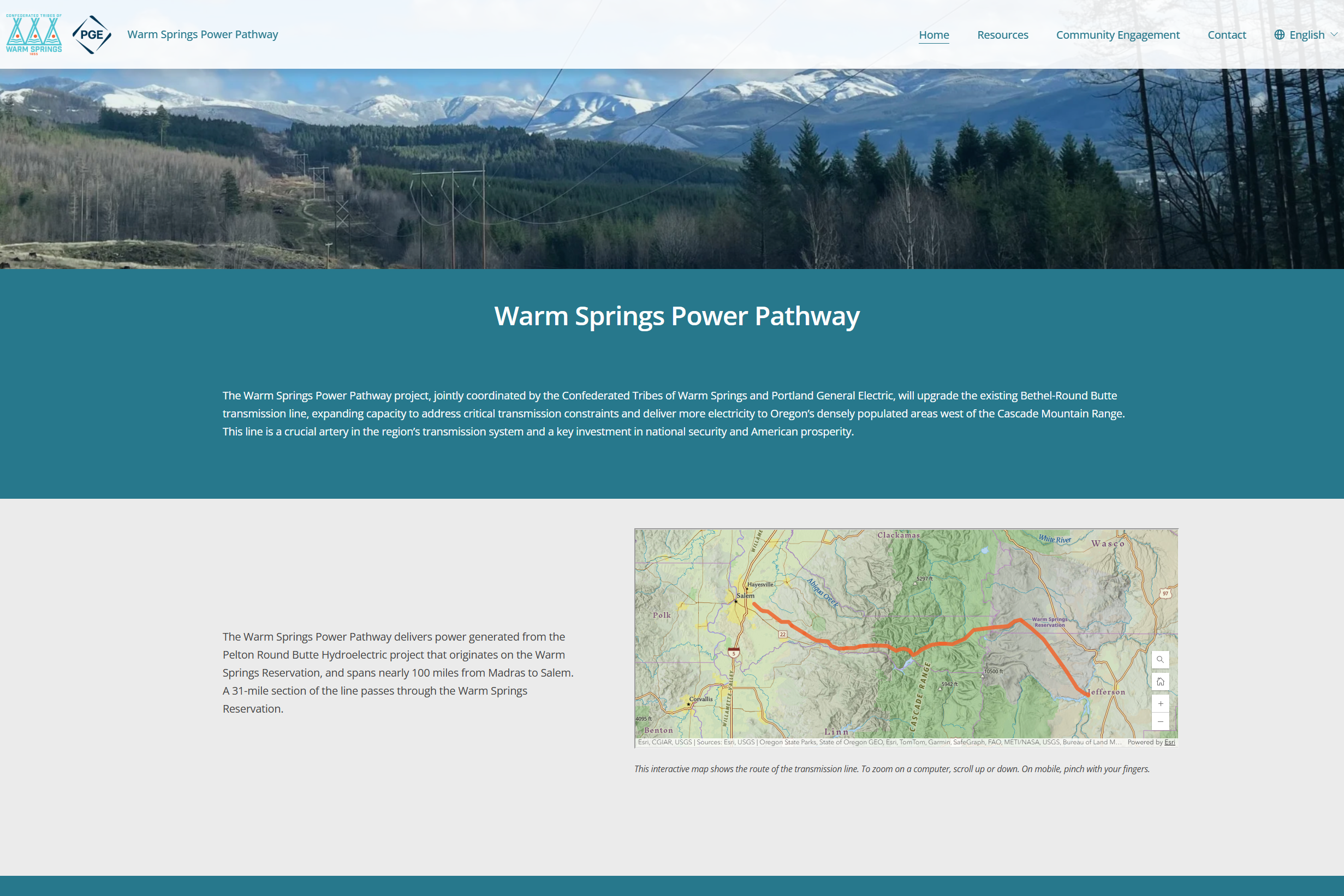
The Warm Springs Power Pathway website was created to support early and sustained public engagement for a technically complex transmission line project. The site serves as a centralized, accessible source of information designed to explain project impacts in plain language while supporting bilingual access and long-term maintainability.
Page views (first 4 months)
2,000+
Project duration
5–6 years
Accessibility standard
WCAG AA / Section 508
Communicating Complex Infrastructure Clearly
The Problem
The project required early and sustained public communication around why a new transmission line was being built, how it would affect surrounding communities, and how the public could stay informed and provide feedback.
Before the website existed, there was no centralized or accessible platform explaining the project in plain language. Given that construction would take place on private and tribal lands, the risk of confusion, mistrust, or misinformation was high.
Ensuring clarity and equitable access to information was essential for all audiences.
Real-World Platform and Organizational Challenges
Constraints
Squarespace was selected to support long-term client ownership and ease of content updates, but it introduced limitations around advanced interactivity and embedded tools.
The site needed to support an interactive map, a bilingual public survey, and long-term scalability within a CMS environment not designed for heavy customization.
The project also required balancing the priorities of a large utility company and a sovereign tribal nation while maintaining clear, neutral, and accessible public communication.
All work was required to meet WCAG AA and Section 508 standards and follow plain-language best practices.
Designing for Longevity and Accessibility
Approach
The site was designed as a flexible microsite capable of evolving over the life of the project. Core requirements included bilingual support, an interactive map, and a structure simple enough for non-technical users to maintain.
Rather than prioritizing heavy interactivity, the focus remained on clarity, accessibility, and long-term maintainability.
Tradeoffs were made to work within Squarespace’s constraints while selectively using custom code where it provided clear value.
Automated translation tools were avoided due to the risk of inaccuracies. Since Spanish was the only required secondary language, Weglot was selected for its editable translations and professional review workflow.
Clarity, accessibility, and trust were treated as core design requirements—not enhancements.
Implementation Highlights
- Designed scalable website mockups with clear information hierarchy
- Built a bilingual Squarespace site with intentional navigation
- Integrated an ArcGIS interactive map to visualize the transmission line route
- Implemented a bilingual Jotform survey with custom JavaScript language synchronization
- Defined accessible brand colors and visual styles
- Developed a responsive, custom project timeline using HTML, CSS, and JavaScript