Home / Case studies / Legacy Interactive Comment Map System
Legacy Interactive Comment Map System
Client / Partners
Multiple public-sector agencies
What I did
- Role: Frontend Engineer, System Maintenance Owner
- Timeline: Ongoing maintenance across multiple deployments
Tools / Platform
- Platform: Bolt CMS, PHP, Google Maps API, JavaScript
- Focus: System stability, debugging, risk mitigation
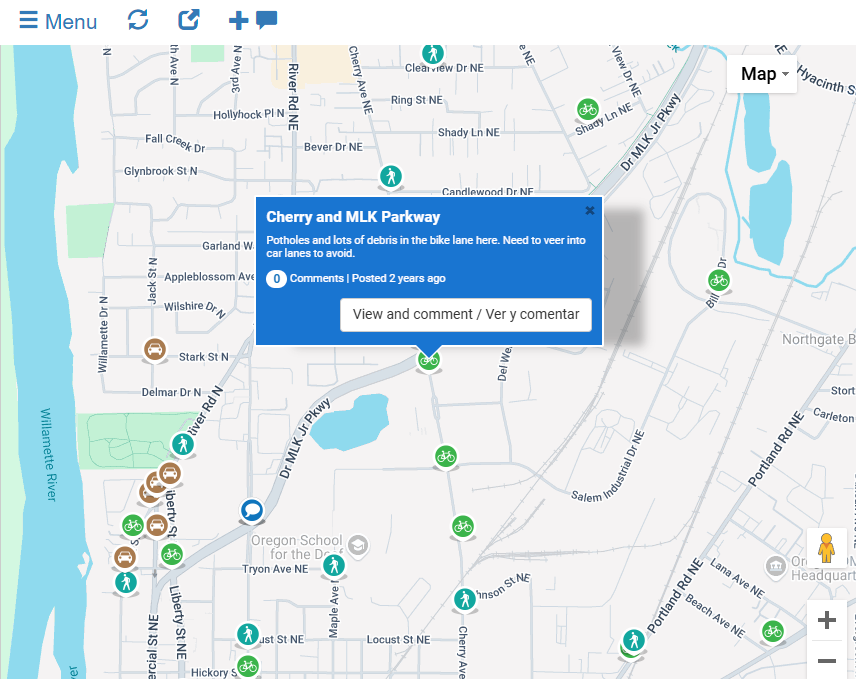
The Legacy Interactive Comment Map System is a production tool used by government agencies to collect geographically specific public feedback for infrastructure and planning projects. I inherited responsibility for its stability and ongoing maintenance, ensuring reliability under legacy constraints while avoiding regressions in active public deployments.
Public responses per deployment
2,000+
System status
Production, multi-project use
Primary risk
Legacy dependencies & undocumented architecture
Stabilizing a Business-Critical Legacy System
The Challenge
The system was already deployed across multiple public engagement projects and actively collecting live public input.
It relied on outdated software, undocumented architecture, and legacy dependencies, increasing the risk of failures over time.
A full rebuild was not feasible due to budget, staffing, and scope constraints, requiring careful maintenance rather than redesign.
Operating Under Real-World Limitations
Context & Constraints
The application ran on an older CMS with legacy PHP versions and no formal version control.
Dependencies and architectural decisions were undocumented, requiring reverse engineering.
The system was used in live public engagement efforts, limiting tolerance for breaking changes.
Any changes needed to be low-risk, reversible, and compatible with existing deployments.
Taking Responsibility for an Inherited System
Role & Ownership
Although I did not originally build the system, I assumed full ownership of its ongoing stability and maintenance.
My responsibilities included auditing inherited code, diagnosing production issues, and implementing fixes without introducing regressions.
I was responsible for deciding when changes were appropriate—and when restraint was the safer engineering choice.
Risk-Aware Debugging in Production
Approach
Given the lack of documentation and version control, I prioritized incremental, testable changes over refactoring.
I mapped data flow from form submission to map rendering and isolated dependencies affecting frontend behavior.
Changes were made one at a time, with isolated backups and immediate validation to preserve system integrity.
Diagnosing a Map Rendering Failure
Key Intervention
A production issue caused only the first map marker to render correctly, while subsequent markers failed or collapsed into default behavior.
Data integrity and looping logic were confirmed, indicating the issue was isolated to the marker rendering layer.
I temporarily replaced the custom marker and label implementation with a baseline Google Maps marker to reduce variables.
All markers rendered correctly, confirming the failure point and allowing safe remediation without destabilizing the system.
Preserving Usability Under Constraints
Accessibility & UX
While large-scale UX changes were not feasible, care was taken to avoid introducing accessibility regressions.
Existing Bootstrap-based patterns were preserved, and changes were tested for keyboard interaction and clarity.
Where improvements could not be safely implemented, limitations were documented rather than forced.
Restored Reliability Without Regression
Outcome
Marker rendering was stabilized across deployments without breaking existing behavior.
The system became more predictable and easier to reason about, reducing the risk of future failures.
The tool remained operational for public-facing engagement while longer-term modernization options were evaluated separately.
Engineering Judgment in Production Environments
Why It Matters
This project demonstrates the ability to take ownership of undocumented legacy systems and stabilize them safely.
It highlights risk-aware debugging, production responsibility, and the discipline to balance improvement with operational trust.
This project required engineering judgment and restraint more than new feature development.
Implementation Highlights
- Stabilized a production system used in live public engagement
- Diagnosed complex rendering issues in undocumented legacy code
- Applied risk-aware debugging strategies to avoid regressions
- Maintained system reliability without full refactor or rebuild
- Balanced technical improvement with operational responsibility